
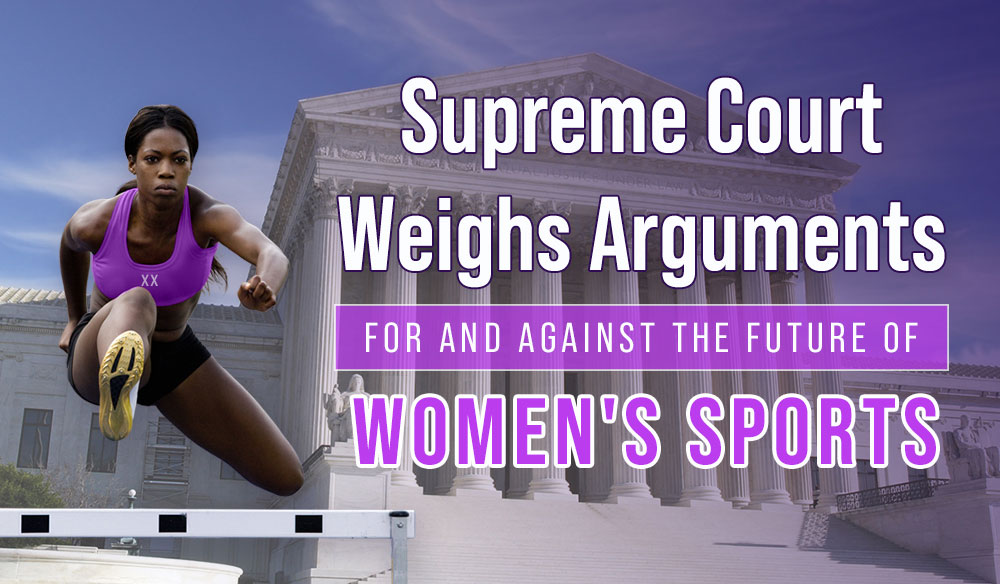

Supreme Court Weighs Arguments for and Against the Future of Women’s Sports
All eyes turned to Washington, D.C., last week to watch two consequential cases before the Supreme Court. When the decisions are rendered this summer, they will inform whether states have a right to ban biological boys and men from girls’ and women’s sports.
They will decide on women’s safety on sporting fields, their right to privacy in the locker room, and whether women will continue to enjoy the rights afforded to them by Title IX.
When the lines of biological reality are blurred, it deprives women and girls of the equal opportunities Title IX was established to protect.
The cases:
Little v. Hecox
Idaho was the first state to pass a law protecting women’s sports. The Fairness in Women’s Sports Act requires biological sex to determine whether an athlete can compete in girls’ and women’s sports in public schools from elementary school through college. Lindsay Hecox (24), a biological male who lives as a woman, is the plaintiff in this case, which was initially filed when he sought to try out for the women’s track and cross-country teams at Boise State University.
West Virginia v. B.P.J.
The second case being considered is similar, contesting the ban of transgender athletes (males living as females) from girls’ and women’s sports in West Virginia. Becky Pepper-Jackson is the teen whose mom filed the suit, seeking access for her son to the girls’ middle school sports teams. Though his mom transitioned him to consider himself a girl in third grade, the Save Women’s Sports Act in that state prevents him from participating with the girls.
Men in Women’s Sports – Unfair to Whom?
It’s funny – if you look at coverage on, say, NBC News, it’s presented as a transgender rights issue. If you look at a more conservative mainstream source like Fox News, it’s about protecting women’s sports and spaces. It IS a Women’s issue, and women must be protected.
By now, the verdict is in on the fairness of the issue. We know the scientific data showing that males perform up to 30% better in sports due to advantages like larger hearts and lungs than their female counterparts, more muscle mass, and greater bone density. This gives them greater speed and power.
Just ask talented female Olympic boxer Angela Carini from Italy, who was pummeled, lasting only 46 seconds in the ring with Imane Khelif, who claimed to be female but had XY chromosomes. The short beating at the Paris Olympics was so brutal that Carini quit the match out of fear of serious injury.
Or you could ask one of the thousands of female school-aged athletes who are losing team positions and awards because they now have to compete against males, like Alanna Smith, a high school track star from Connecticut, who found herself forced to compete against two guys. These two athletes took away Alanna’s hope of winning, and they went on to win 15 women’s championship titles in that state.
If commonsense isn’t good enough for you, a study by the United Nations recently revealed that more than “600 female athletes in more than 400 women’s division events across 29 different sports were defeated by transgender-identifying men. Male athletes have taken over 890 medals from female athletes.” Not cool.
If you missed last week’s podcast, you may want to listen to our discussion with Jennifer Sey, seven-time member of the U.S. women’s national gymnastics team and 1986 women’s all-around national champion. She courageously spoke out about the COVID lockdowns and mandates which blew up her career as an executive at Levi Strauss. She shared her incredible story with us, and how the company she founded, XX-XY Athletics, is standing up for female athletes and the protection of women’s sports.
Riley’s Riled!
In some comments about the cases given at a press conference just before things got underway at the Supreme Court, athlete and activist Riley Gaines offered her thoughts – and didn’t hold back.
“Truthfully, I’m pissed off…that we’ve reached a point where we seemingly have an entire political party who has diminished and erased our rights as women… Don’t let them frame it any other way. They love to hide behind words like compassion and empathy, and inclusion.”
She recalled her own experiences being forced to compete against and undress in front of biological male athletes. “Let me be very, very clear. What me and what my teammates faced – it was not inclusive. It was exclusive because we as women were excluded from participating, from competing, from calling ourselves champions because we were sent the message…We were told loud and clear that our rights to safety, our rights to privacy in areas of undressing, our rights to equal opportunity… didn’t matter. They certainly didn’t matter as much as the boy’s feelings, the man’s feelings, his happiness. We were told that mattered more than our rights.”
One would think that it would be a 9-0 decision in favor of women’s sports. It seems logical that it would be a slam dunk. But then they begin to delve into the definition of the sexes, and we know that at least one Justice can’t go there.
Through the Looking Glass
Tuesday, January 13th, the cases devolved into a discussion of what a woman is. It’s always fun to watch lawyers and justices grapple with the definition of the biological sexes. Really, it’s pop-the-popcorn-you-gotta-see-this time, stifling our chuckles as they try to figure out what we’ve all known since – well, forever?
When Justice Samual Alito asked, for the purpose of defining “equal protection,” for an “understanding of what it means to be a boy or a girl or a man or a woman,” he looked to the plaintiff’s lawyer.
Hecox’s attorney then served up a little word salad with no real answer. Classic.
Ever since Supreme Court Justice Ketanji Brown Jackson said she couldn’t define what a woman was in her confirmation hearings, it’s been must-see-TV when they get to talking about this.
Spoiler – a woman is a female human.
But then again, I’m no biologist.
Moms for America Rallies for Women
Groups supporting women and a smaller contingent of those favoring the transgender position rallied outside the Supreme Court. Our own Debbie Kraulidis led a powerful contingent of moms who stood their ground for girls’ and women’s sports.
Debbie explained the reason for the gathering, “[These are] two key cases that will define women’s sports. It’s unreal that we actually have to create laws in order to protect our girls’ sports and their spaces, but that’s what we have to do. They’ve been challenged, and we are praying that the Supreme Court makes the right decision to protect our girls.”
Where We Stand
Last spring, a New York Times poll revealed that nearly 80% of Americans do not want biological males in women’s sports. The classic 80/20 issue. To date, 27 states have passed laws safeguarding women’s sports, while 21 allow the unfair inclusion of boys and men in girls’ spaces. Most pundits agree that, after the arguments were completed, it’s likely the Supreme Court will allow states to maintain the bans. That final decision is expected in June.
What about the remaining states that support the degradation of women’s sports? Word from Press Secretary Karoline Leavitt is that President Trump intends to take action on behalf of women and girls in America. Stay tuned.
Podcast Note: We had a captivating conversation with Angela Morabito and Paul Zimmerman of the Defense of Freedom Institute, who explore “The Fall Of Woke?” in their latest report, exposing how teacher unions continue to double down on woke ideology despite public objections.
***